Scaling ForgeSDLC
ForgeSDLC was designed for small, focused teams. But the principles that make it effective at the team level can extend to multi-team and enterprise contexts — without adding SAFe-level process weight.
Scaling principles
- Scale the knowledge, not the process. Add discipline blueprints, not coordination layers.
- Inter-team Versonas replace synchronization meetings. When teams need to coordinate, relevant Versonas are invoked with the cross-team knowledge each decision needs.
- The Charge view aggregates, it doesn't control. Each team owns its Charge; leadership sees an aggregated lens.
- Forge Principles apply at every scale. If a coordination mechanism adds more weight than the waste it prevents, remove it.
Multi-team patterns
Shared Blueprint Repository
All teams use the same blueprints submodule. This ensures consistent quality gates and terminology across the organization.
Cross-team Versonas
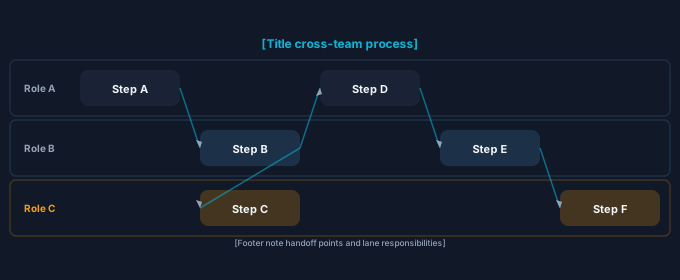
When a decision affects multiple teams (API contract change, shared infrastructure modification, platform migration), cross-team Versonas are invoked:
- Identify affected teams — which teams' Sparks are impacted?
- Pull relevant blueprints — Architecture (API design), DevOps (deployment), Testing (integration tests)
- Each team sends a representative — the person closest to the affected Sparks
- Decision is logged — all affected teams update their journals
- Sparks are updated — new Sparks created if needed, existing Sparks re-estimated
Milestone Versonas
Quarterly milestone reviews operate as high-level Versona sessions:
| Aspect | Detail |
|---|---|
| Trigger | End of milestone period |
| Participants | Team leads, product owner, architecture lead |
| Blueprints applied | SDLC (phase review), PDLC (product lifecycle), PM (schedule/risk) |
| Output | Next milestone scope, cross-team dependency map, risk register update |
These reviews are for milestone and portfolio alignment. They do not replace each team’s iteration retrospective (process improvement) or its daily sync.
Enterprise integration
Governance without bureaucracy
Enterprise governance needs can be met through discipline blueprints:
- Compliance blueprints encode regulatory requirements (GDPR, HIPAA, SOX) as quality gates
- Security blueprints enforce organizational security policies through Versonas
- Architecture blueprints maintain enterprise architecture standards through decision records
Portfolio visibility
The aggregated Charge view provides portfolio-level visibility:
- Active Sparks across all teams (total throughput)
- Pending Versona sessions (upcoming decisions that may need escalation)
- Blueprint coverage (which disciplines are actively used)
- Decision velocity (how quickly Versona sessions produce outcomes)
Compatibility with existing frameworks
ForgeSDLC can coexist with enterprise frameworks:
| Framework | Integration pattern |
|---|---|
| TOGAF | Architecture blueprints map to TOGAF phases; ADRs feed the architecture repository |
| ITIL | DevOps blueprints incorporate ITIL change management as Versona gates |
| ISO 27001 | Security blueprints encode ISO 27001 controls; Versona sessions serve as evidence |
| CMMI | Blueprint policies map to CMMI process areas; Forge journals provide process evidence |